New Sea Alarm Brochure
Sea Alarm recently produced a brochure, which provides an overview of its objectives and main activities. Please contact us to order a printed copy.
To register for this unique event 5 day event, which will take place in Tallinn, Estonia from 5-9 October, please visit the registration page of the EOW website where you will be directed to the on-line booking service. A detailed description…
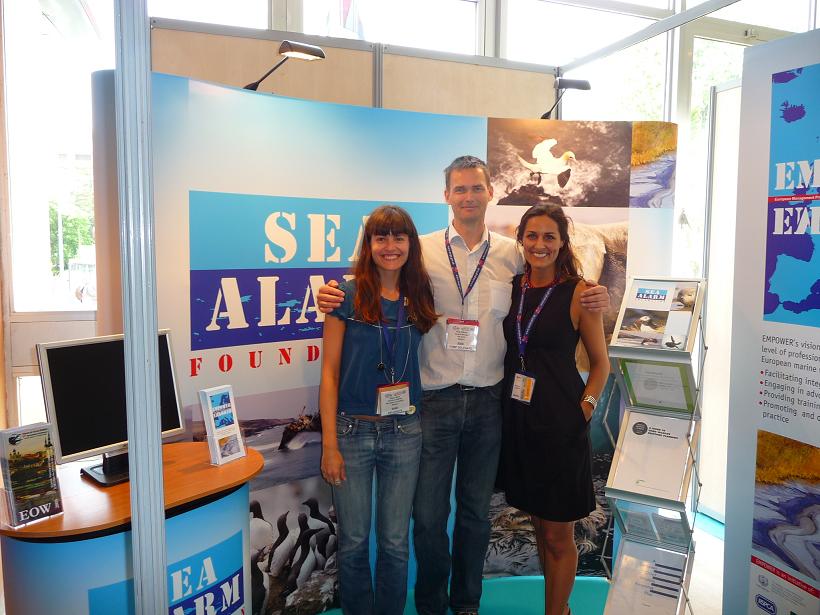
Sea Alarm had a very productive and enjoyable week at the recent Interspill Conference and Exhibition in Marseille, France.
Sea Alarm booth’s benefitted from an exceptional position in the exhibition hall, just next to the entrance door. This offered Sea Alarm’s staff an unparalleled opportunity to meet and consult with a large number of representatives from European governmental agencies and the oil spill industry. EMPOWER, Sea Alarm’s new initiative to professionalise the response of NGOs to marine wildlife emergencies, piqued the interest of many delegates, especially as EMPOWER was highlighted in the Interspill Catalogue.
Sea Alarm is pleased to announce the appointment of Baron Leo Delwaide, as the new Chairman of the Sea Alarm Board of Directors. Baron Delwaide succeeds Mr Roelf de Boer, who in his three years as chairman was instrumental in forging strong alliances with the oil industry and in securing structural funding. Sea Alarm extends its sincere thanks to Mr. de Boer for his commitment and service.
The Call for Papers and Posters for the 10th International Effects of Oil on Wildlife (EOW) Conference is now open. Prospective authors are invited to submit a 200-300 word abstract for consideration by the 1st June 2009. Abstracts will be reviewed by the Program Committee and successful applicants will be asked to provide an extended abstract/paper prior to the Conference for inclusion in the Proceedings.
The first Steering Group meeting of the EMPOWER Network will be held in Brussels on 8th May. This is the first meeting of the representatives from the nine Founding Members of the Network, who are tasked with drafting the rules…
We are delighted to announce that after nine years of planning, lobbying and construction works, VOC Ostend, an EMPOWER Founding Member, has opened its new Rehabilitation Centre. The new building has the capacity to treat 400-500 oiled birds at a time, and can be upgraded within 24 hours, enabling the centre to treat up to 1000 birds.
Representatives from the coastal municipalities, national authorities, rehabilitation
centres and scientific institutes will get together on 9th April in the Hague to officially sign the Netherland’s national oiled wildlife contingency plan. Sea Alarm has been invited to give an introduction to oiled wildlife response, and additional scheduled events include a practical demonstration on bird cleaning techniques and the collection of dead animals.
Due to the heavy seas caused by Cyclone Hamish off the coast of Queensland, Australia, the Pacific Adventurer lost thirty-one containers holding ammonium nitrate on 10th March, puncturing two fuel tanks in the process. The subsequent oil spill, estimated to be up 42 tonnes, contaminated pristine beaches in a large area of south-east Queensland.
Fortunately, the spill seems to have had a minimal effect on birdlife.
In March, Hugo Nijkamp attended a meeting at the Ministry of Environment in Tallinn, Estonia together with representatives from the Estonian Ministry of Environment, the HELCOM Secretariat and WWF Finland. Together, the participants discussed a proposal that will be submitted at upcoming HELCOM RESPONSE meeting in September, which seeks to integrate oiled wildlife response into the existing Helcom Response Manual.
Whilst in Tallinn, Hugo also met with Agni Kaldma and Juri-Ott Salm of the Estonian Fund for Nature (ELF), the local partner and co-host of the 10th Effects of Oil on Wildlife Conference.
On 14th February, an estimated 500-1000 tonnes of oil spilled out into the Celtic Sea, close to where the Russian aircraft carrier Admiral Kuznetsov was refuelling, threatening the Irish and Welsh coastlines. The Irish Marine Department described the spill as the biggest spill to hit the area in a decade. Although no oiled birds were found washed up on the shorelines, mainly because the spill occurred so far off shore, experts believe that seabirds must have been affected as high densities of wintering birds are normally found in the area.